
ABSTRAK
PERBAIKAN KOTORAN HEWAN DENGAN MENCAMPUR DENGAN ZEOLIT ALAM. Saat ini Indonesia sedang menghadapi krisis ekonomi. Situasi ini disebabkan karena strategi pengembangan industri nasional tergantung pada bahan-bahan import, sebagai contoh pada pertanian. Pada kasus ini kebutuhan nasional tergantung pada pupuk import, sehingga membuat cadangan makanan menurun. Penelitian ini direncanakan untuk memilih alternatif lain dalam penyiapan dan produksi pupuk yang kita butuhkan untuk mengatasi masalah ini.Komposisi baru dari pupuk kandang telah dibuat dengan menambahkan zeolit alam dari Cikancra Tasikmalaya dan Kedung Banteng, Malang untuk mendapatkan kandungan nitrogen yang tinggi. Karakterisasi yang dilakukan meliputi , komposisi zeolit alam dan pupuk kandang dengan menggunakan AAS dan analisa Kyedhal, analisa struktur dengan XRD dan SEM serta KTK. Hasil dari penelitian memperlihatkan bahwa penambahan zeolit alam pada kotoran hewan dapat menaikkan kadar nitrogen dan mengurangi kadar air pada pupuk kandang. Penyerapan amonia oleh zeolit alam yang mempunyai ukuran –8 +10 mesh hampir sama dengan penyerapan amonia oleh zeolit alam yang mempunyai ukuran –14 +20 mesh. Zeolit alam dari kedung Banteng menyerap nitrogen lebih baik daripada zeolit Cikanra. Penyerapan air oleh zeolit alam yang mempunyai ukuran baik – 8+10 maupun –14+20 mesh hampir sama. Pupuk kandang yang dicampur zeolit alam Kedung Banteng lebih kering bila dibandingkan dengan pupuk kandang yang dicampur dengan zeolit alam Cikancra. Pupuk kandang yang dihasilkan mempunyai kadar nitrogen lebih tinggi, kering dan tidak berbau
Kata Kunci: Kotoran hewan, zeolit alam
INTRODUCTION
Indonesia is an archipelago which rich in natural resources including natural zeolites. More than 50 zeolite deposits have been identified distributing mainly in Sumatra, Java, Sulawesi, Nusa Tenggara and Maluku, although the application in It is well known that among the nutrient elements which agriculture is still limited in small scale. The most important properties of natural zeolites are cation exchange capacity (CEC) , capability to capture ammonium ion , to absorp water and gas. These properties might be exploited for many utilization including agriculture.
often limits the yield of crops, nitrogen (N) is the important and it is often the key to increase production. Ammonia from the excrement (wastes) usually loss to the air, causing the fertilizer poor in nitrogen. To reduce nitrogen loss , zeolites which have capability to capture ammonium ion might be used by mixing them with excrement. The objectives of these experiments were to evaluate the possibility of utilization natural zeolites for improving the organic fertilizer through adsorbing water and NH3 from excrement (animal waste) of the livestock (cow). It causes that the animal manure become high in N (nitrogen) content, drying, low of larva , not stink and limited leach in rain water.
Applications of zeolite for improving of the manure fertilizer are expected to give some positive yields and creating some benefits to maximize the Indonesia natural zeolite utilization.
METHODS
Natural zeolite from Cikancra, Tasikmalaya, West Java and Kedung Banteng , Malang , East Java were used. The excrement of cow was directly taken from Lembang , Bandung.
Preparation of natural zeolite, the materials was ground and sieved to A–8 +10 mesh and –14 +20 mesh.
Characterisation of natural zeolites, includes :
- Identification of mineral by XRD and SEM
- Chemical analysis by AAS and Kyedhal analysis
- CEC
Mixing (manure fertilizer treatment) 25 gr of each natural zeolite was mixed by excrement of cow. The ratio of excrement and natural zeolite are : 2 : 1, 3 : 1, 5 : 1. Half of the samples was mixed by natural zeolite of particle sizes between –8 + 10 and the other half by natural zeolite of particle sizes –14 +20. The control was excrement without mixed by natural zeolite.
During the mixing periode, the mixture was dried by air in room temperature. After 1 (one) month, the contents of N, P2O5, K,Ca, Mg and H2O were analyzed by AAS and Kyedhal methods.
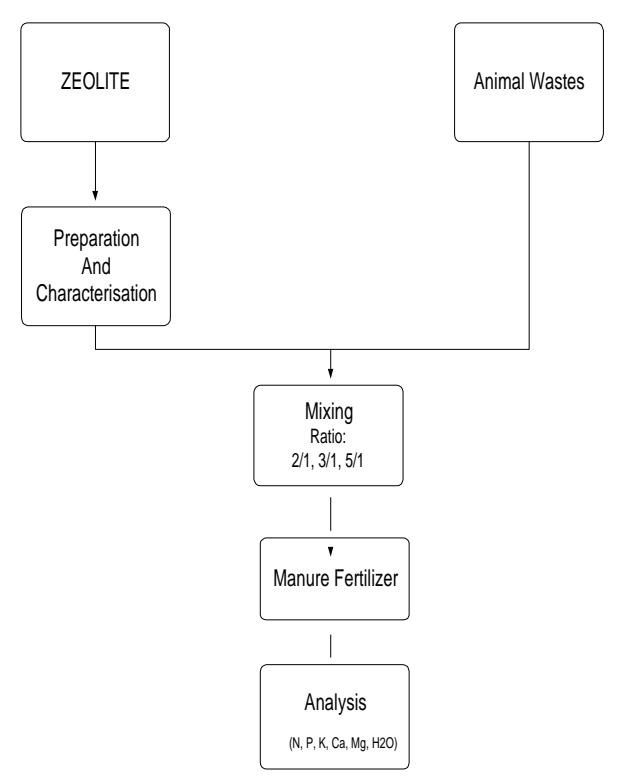
Fig.1. FLOWCHART OF ANIMAL MANURE PROCESS
RESULT
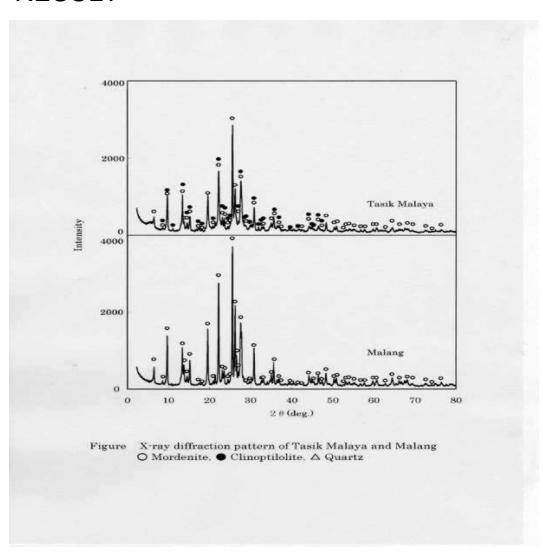
Fig.2. X-Ray Diffraction of Zeolite Tasikmalaya, West Java & Zeolite Kedung Banteng, Malang, East Java Indonesia
Fig.3, SEM Photograph of Zeolite Cikancra Tasikmalaya, West Java, Indonesia
Fig.4. SEM Photograph of Zeolite Kedung Banteng, Malang, East Java, Indonesia
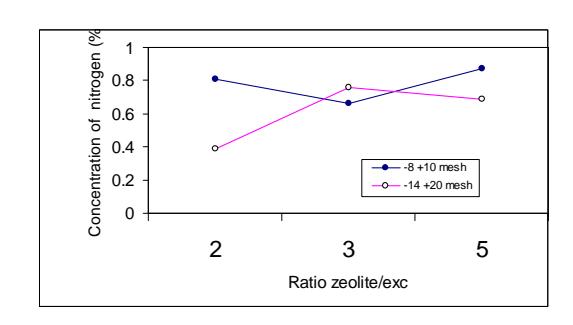
Fig.5. Relationship between concentration of Nitrogen and the ratio of excrement – zeolite Cikancra of Nitrogen and the ratio of excrement – zeolite Kedung Banteng
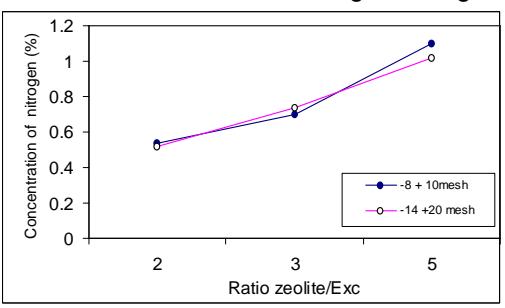
Fig.6. Relationship between concentration of Nitrogen and the ratio of excrement – zeolite Kedung Banteng
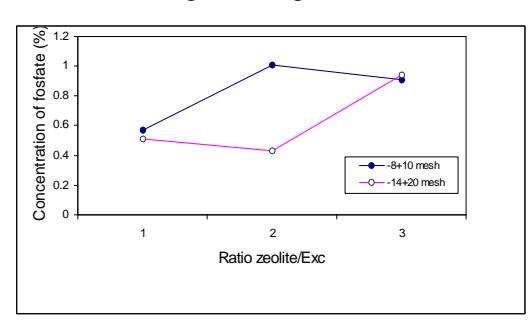
Fig.7. Relationship between concentration of \(P_2O_5\) and the ratio of excrement – zeolite Cikancra
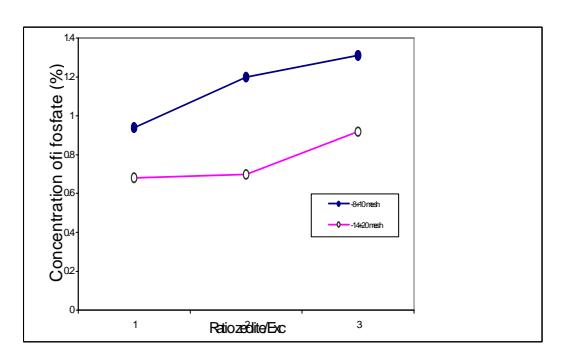
Fig.8. Relationship between concentration of \(P_2O_5\) and the ratio of excrement – zeolite Kedung Banteng
Table 1: The Chemical composition of natural zeolite Cikancra, Tasikmalaya, West Java and Kedung Banteng, Malang, East Java.
| No. | Composition *) | Concentration (Wt %) | |||
|---|---|---|---|---|---|
| Cikancra | Kedung Banteng | ||||
| 1. | SiO2 | 66.64 | 67.38 | ||
| 2. | Al2O3 | 11.98 | 11.66 | ||
| 3. | Fe2O3 | 0.89 | 0.56 | ||
| 4. | MnO | 0.01 | 0.02 | ||
| 5. | TiO | 0.45 | 0.7 | ||
| 6. | P2O5 | 0.04 | 0.04 | ||
| 7. | CaO | 0.14 | 0.18 | ||
| 8. | MgO | 0.14 | 0.04 | ||
| 9. | Na2O | 3.07 | 4.22 | ||
| 10. | K2O | 0.93 | 1.07 | ||
| 11. | LOI | 15.65 | 13.88 | ||
| 12. | H2O- | 4.69 | 2.93 | ||
*) Quantitative analysis by AAS (Shimadzu )
Table 2 : C.E.C of Natural Zeolite Cikancra, Tasikmalaya, West Java and Kedung Banteng, Malang, East Java.
| No. | Material | C.E.C ( meq/00 gr ) |
|---|---|---|
| 1. | Zeolite Cikancra | 155 |
| 2. | Zeolite Kedung Banteng | 175 |
Table 3: Chemical Analysis of Animal Manure Mixed by Natural Zeolite from Cikancra, Tasikmalaya, West Java.
| Compositions | A(%) | B(%) | C(%) | D(%) | E (%) | F(%) | Control |
|---|---|---|---|---|---|---|---|
| N total | 0.81 | 0.66 | 0.87 | 0.39 | 0.76 | 0.69 | 0.08 |
| P2O5 | 0.57 | 1.01 | 0.91 | 0.51 | 0.43 | 0.94 | 2.34 |
| CaO | 0.07 | 0.10 | 0.12 | 0.06 | 0.07 | 0.12 | 1.30 |
| MgO | 0.22 | 1.05 | 1.04 | 0.69 | 0.79 | 1.01 | 2.19 |
| K2O | 1.06 | 1.22 | 1.14 | 1.06 | 1.07 | 1.10 | 1.15 |
| H20 | 6.25 | 6.83 | 7.75 | 5.56 | 6.64 | 7.50 | 10.54 |
Note :
A,B and C excrement mixed by natural zeolite with particle size –8 + 10 D,E, and F excrement mixed by natural zeolite with particle size –14 + 20
Control is excrement without mixed by zeolite
Table 4 : Chemical Analysis of Animal Manure Mixed by Natural Zeolite from Kedung Banteng, Malang, East Java.
| Compositions | G(%) | H(%) | I(%) | J(%) | K (%) | L(%) | Control |
|---|---|---|---|---|---|---|---|
| N total | 0.54 | 0.70 | 1.10 | 0.52 | 0.74 | 1.02 | 0.08 |
| P2O5 | 0.94 | 1.20 | 1.31 | 0.68 | 0.70 | 0.92 | 2.34 |
| CaO | 0.07 | 0.09 | 0.17 | 0.07 | 0.07 | 0.10 | 1.30 |
| MgO | 0.48 | 0.48 | 0.72 | 0.41 | 0.49 | 0.74 | 2.19 |
| K2O | 1.11 | 1.09 | 1.10 | 1.03 | 1.11 | 1.20 | 1.15 |
| H20 | 5.72 | 4.91 | 6.53 | 5.08 | 5.18 | 6.23 | 10.54 |
Note :
G,H and I excrement mixed by natural zeolite with particle size –8 + 10
J,K, and L excrement mixed by natural zeolite with particle size –14 + 20
Control is excrement without mixed by zeolite
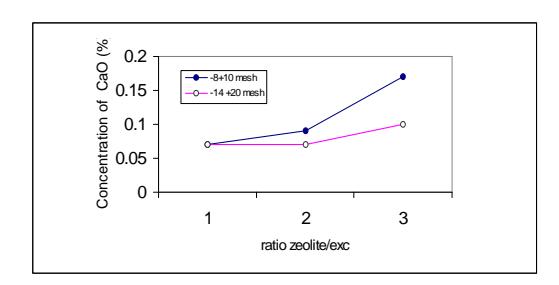
Fig.9. Relationship between concentration of CaO and the ratio of excrement – zeolite Cikancra
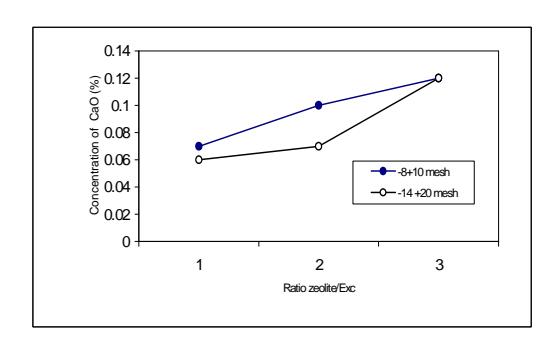
Fig.10. Relationship between concentration of CaO and the ratio of excrement – zeolite Kedung Banteng
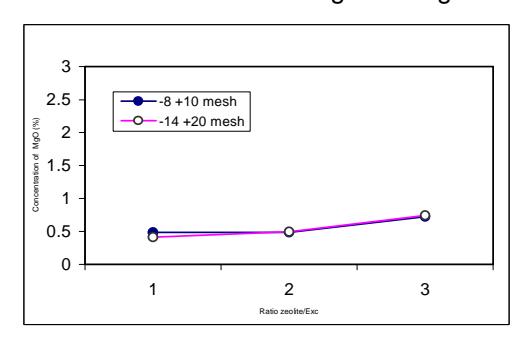
Fig.11. Relationship between concentration of MgO and the ratio of excrement- zeolite Cikancra
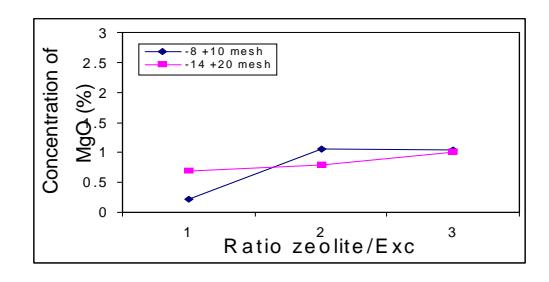
Fig.12. Relationship between concentration of MgO and the ratio of excrement- zeolite Kedung Banteng
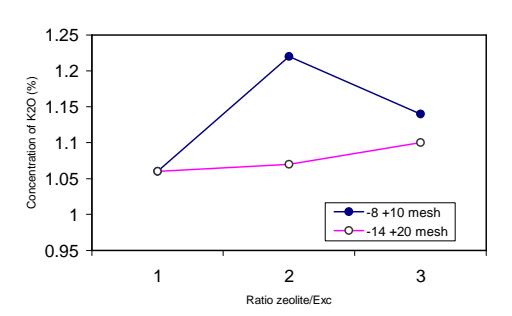
Fig. 13. Relationship between concentration of K2O and the ratio of excrement – zeolite Cikancra
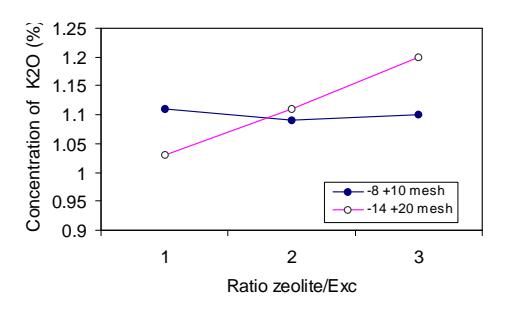
Fig. 14. Relationship between concentration of K2O and the ratio of excrement – zeolite Kedung Banteng
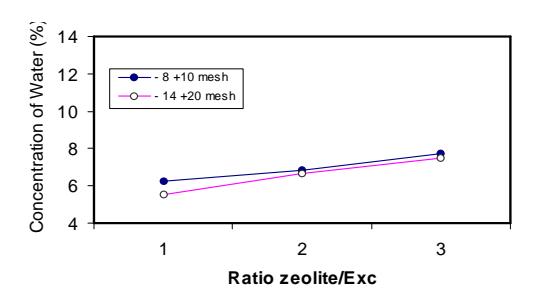
Fig.15.Relationship between concentration of H2O and the ratio of excrement – zeolite Cikancra
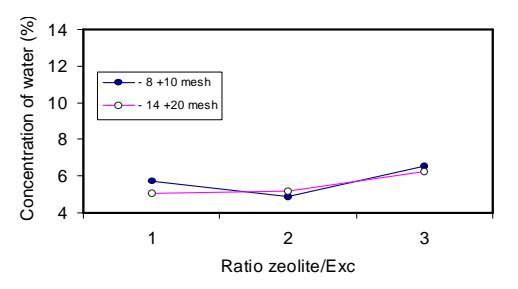
Fig.16. Relationship between oncentration of H2O and the ratio of excrement – zeolite Kedung Banteng
Journal of Indonesia Zeolites
DISCUSSION
X Ray Diffractogram were obtained by RINT 2000, RIGAKU. Cu-K Alpha 1, voltage at 40 kV and current 30 mA were used for this purpose. The mineral compositions of zeolite Cikancra and Kedung Banteng were identified by XRD and presented by X Ray Diffractogram in Fig.2. In zeolite Cikancra the presence of two groups of peaks shows that the sample contained both mordenite and clinoptilolite. Detailed examination also shows that the sample contains quartz as the impurities. Zeolite Kedung Banteng shows only one peak of mordenite. Mordenite and clinoptilolite are two major zeolites found in Indonesia so far. The two minerals have been obtained together in varied propotion. In general the presence of mordenite is more dominant than clinoptilolite.
The minerals form was identified by scanning electron microscop, JEOL JSM – T 3302 and the picture are shown in Fig.3 and 4. Microscopical investigation using SEM confirms the XRD analysis results that Cikancra natural zeolite is formed by both mordenite and clinoptilolite and Kedung Banteng natural zeolite is only by mordenite. For Cikancra natural zeolite , mordenite is found in the form of fibrous and needle, while clinoptilolite is in platy and octahydral form . In Kedung Banteng natural zeolite , mordenite is found in the form of fibrous.
Quantitative chemical analysis was carried out using Atomic Absorption Spectrofotometer Shimadzu . Results of chemical analysis are presented in Table 1. Silica and alumina are forming the major composition of zeolites. Zeolites are known as a crystalline frameworks of oxygen, alumunium and silicon extending in a three dimensional framework. If an alumunium atom present rather than a silicon atom , a positive metal ion is required to maintain a charge balance. The cation are loosely bound in the structure and maybe exchanged, to varying degrees, by each other. Based on chemical analysis, sodium is the main cation in zeolite Cikancra and zeolite Kedung Banteng. Sodium has been known as the main cation in mordenite and clinoptilolite structures. Other elements present in the zeolites are potassium, calsium and magnesium. Those elements are contamination in zeolite structure and can be exchanged. Other contaminant is iron.
The number of water molecules in crystal structure is agreeable with pore or crystal space volumes when the crystal unit cell is heated . LOI value of natural zeolite from Cikancra and Kedung Banteng are 15,65 % and 13.88 %, it can be considered as a high LOI. High LOI Value is also an indication of high zeolite content in rocks and low LOI is related with low zeolite content.
Zeolite with high LOI can be expected to have a good capability to be used as absorbent. Adsorption property of zeolite is useful for application as dryer, deodorize , etc. Cation exchange capacity (C.E.C) values of natural zeolite from Cikancra, Tasikmalaya, West Java and from Kedung Banteng, Malang are given in Table 2. ( 155 and 175 meq/ g ). This is the number of cation that can be exchanged by zeolites without activation. C.E.C value above 100 meq/g can be considered as high for natural zeolite and it reflects the good quality of zeolite Cikancra and zeolite Kedung Banteng. This cation exchange property may be used for several zeolite applications in agriculture (fertilizer, releasing agent, etc.) . Animal Manure analysis results by kyedhal are given in Table 3 and 4. The content of N from the control specimen ( animal manure without zeolite) is 0.08, lower than the content of N from animal manure which mixed by zeolite.
Fig.5 and 6, show that the content of N increased with increasing excrement percentages. Ammonia absorption by natural zeolite with particle size either – 8+10 or –14+20 mesh is almost similar, because the selection of particle size is to close. The nitrogen content of animal manure which mixed with natural zeolite from Kedung Banteng, Malang is bigger than that which mixed with natural zeolite from Cikancra, Tasikmalaya. Due to C.E.C value and the impurities, the quality of natural zeolite from Kedung Banteng is better than natural zeolite from Cikancra.
In Table 3 and 4, the content of P2O5 from control specimen 2.34.Fig.7 and 8, show the content of P2O5 from animal manure
lower than the control specimen, due to addition of zeolite into excrement. The content of P2O5 increase with increasing excrement percentages.
In Table 3 and 4, the content of CaO from control specimen is 1.30.Fig.9 and 10, show that the content of CaO from animal manure is lower than the control specimen. The content of CaO increases with increasing excrement percentages.
In Table 3 and 4, the content of MgO from control specimen is 2.19. Fig.11 and 12, show that the content of MgO from manure fertilizer is lower than the control specimen. The content of MgO increases with increasing excrement percentages.
In Table 3 and 4, the content of K2O from control is 1.15. Fig.13 and 14, show that the content of K2O from animal manure lower than the control specimen. The content of K2O increases with increasing excrement percentages.
In Table 3 and 4, the content of H2O from control specimen is 10.54. Fig.15 and 16, show that the content of H2O is lower than the control. The absorption of water by natural zeolite with particle size of either – 8 +14 or –14+20 mesh is almost similar, because the selection of particle size is to close. Animal manure which is mixed with natural zeolite from Kedung Banteng is dryer than that which mixed with natural zeolite from Cikancra.
All zeolites are moleculer sieves, because of their internal structure, and can selectively adsorp molecul according to their size and/or shape. The size shape and charge of the adsorbed phase also influence molecular sieving. Water and amonia which have diameter about 3 A°, enter the framework of mordenite and/or clinoptilolite. Ammonium from urine and excrement which is usually lost to air, can be absorped. It causes animal manure is high nitrogen content. with same mechanism water and odours from urine and excrement can also be absorbed, it causes animal manure product dryer and more malodorous. Furthermore based on their attractive ion exchange, adsorption and hydration properties, natural zeolites
have been found to act as slow release fertilizers to provide potasium and nitrogen to agriculture soils, as carriers of herbicides, fungisides and insecticides. Zeolite has also been found to improve the nutrients such as Fe, Mn, K, Ca, Mg and P (see Table 1.).
SUMMARY
- 1. Natural zeolite from Cikancra, Tasikmalaya, West Java contained both mordenite and clinoptilolite. Quartz and montmorillonite are the impurities.Natural zeolite from Kedung Banteng , Malang, east Java contained only mordenite without the impurities.
- 2. C.E.C value are 155 meq/100g and 175 meq/100g, which means that zeolites Cikancra and zeolite Kedung Banteng are a good quality. Due to its high C.E.C value, zeolite Cikancra and zeolite Kedung Banteng can be used in agriculture such as fertilizer and releasing agent.
- 3. LOI are 14.950 % and 13.88 % It reflects the high content of zeolite mineral in rocks. Due to its high LOI, zeolite Cikancra can be used as a drying and odour control.
- 4. The addition of natural zeolite to excrement (animal wastes), increase the content of nitrogen in animal manure.
- 5. Ammonia absorption by natural zeolite with have particle size of either –8 +10 or –14+20 mesh almost similar. The nitrogen content of animal manure which mixed with natural zeolite from Kedung Banteng, Malang was bigger than that which mixed with natural zeolite from Cikancra, Tasikmalaya.
- 6. The addition of natural zeolite to the excrement decrease the content of water in animal manure .
- 7. The absorption of water by natural zeolite with have particle size of either –8 +10 or –14+20 mesh almost similar. Animal manure which mixed with natural zeolite from Kedung Banteng, Malang was dryer than that which mixed with natural zeolite from Cikancra, Tasikmalaya.
- 8. The produce of animal manure has better properties like a high in nitrogen content, dry and not malodorous.
50%HDTMA
REFERENCE
Journal of Indonesia Zeolites
- 1. Barrer R.M. (1978) Zeolites and Clay Minerals as Sorbents and Moleculer Sieves. Academic Press. London.
- 2. Djadjuli,Apud , The Report of Zeolite Utilization as a layer of Chicken at Taman Ternak Ragunan Dki- Jakarta.
- 3. Bandung ; Pusat Pengembangan Teknologi Mineral, 1990.
- 4. L.B. Sand and F.A. Mumpton (1978) Natural Zeolite, Occurance Properties, use Pergamon 451 – 462.
- 5. Tsitsishvili, G.V. et.al. Natural Zeolites England ; Ellis Horward Limited. 1992. p.295
- 6. Goto, I., 1990.The Application of Zeolite In Agriculture: Effects of zeolite on soil improvement. Zeolite, 7 (3) 8- 15.
- 7. Pusat Pengembangan Teknologi Mineral. 1990. Kegunaan dan Prospek Zeolit di Indonesia. Laporan Ekonomi Bahan Galian, No 72.
- 8. Suwardi, et al. The quality of Natural Zeolites from Japan and Indonesia and Their Application Effects for Soil Amendment. Jour. Agri. Sci. Tokyo Nogyo Daigaku, 39 (3), 133-148 (1994).