
FOREWORD TO JULY 2026 EDITION
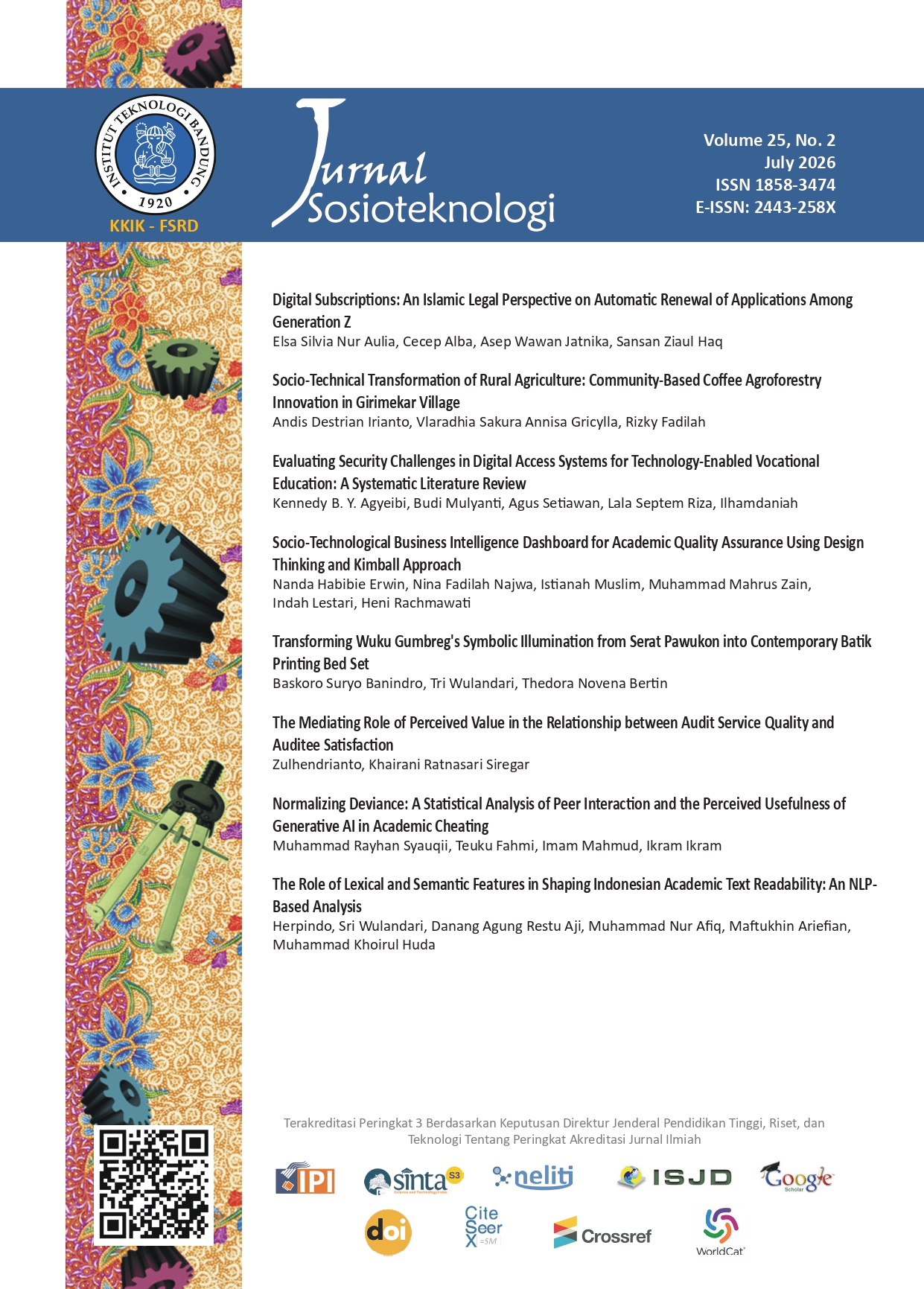
Every technology carries a social contract with it — sometimes explicit, more often assumed. This July 2026 edition gathers eight studies that make those contracts visible, and in doing so, ask what happens when the assumptions no longer hold.
Three articles trace how digital systems reshape everyday commitments. A study on auto-renewal subscriptions reads Generation Z's "subscribe-and-forget" habit through fiqh muamalah, arguing that continuous consent — not just an initial click — is where fairness lives. A systematic review of digital access security in vocational education shows that when the login fails, so does the classroom. A statistical analysis of peer influence and generative AI finds that academic cheating is learned socially before it is executed technologically.
Three others examine how institutions absorb new tools. A business intelligence dashboard built with design thinking and the Kimball approach reduces academic quality-assurance processing time by roughly 99% while shifting staff work from data entry to interpretation. Perceived value is shown to mediate the relationship between audit service quality and auditee satisfaction in a state-owned electricity enterprise, positioning empathy alongside technical competence. An NLP (natural language processing) analysis of Indonesian academic writing finds that semantic clarity, not lexical sophistication, predicts readability.
The remaining two look outward. Community-based coffee agroforestry in Girimekar Village illustrates how rural innovation emerges through negotiated multi-actor networks rather than technological adoption alone. And Wuku Gumbreg's Serat Pawukon illumination is transformed into contemporary batik-print bed sets, showing that cultural heritage travels well when its symbolic grammar is respected.
Read together, these studies remind us that sociotechnology is never only technical — and never only social.
Regards,
Editor-in-Chief

 Abstract views:
96 times
|
Abstract views:
96 times
|
 Downloaded:
118 times
Downloaded:
118 times


